Quartzite vs Quartz Countertops for Southwest Florida Kitchens
Bright sun, coastal humidity, sandy hands, and busy family meals all affect a kitchen countertop choice. When comparing quartzite vs quartz countertops , Southwest Florida homeowners need more than a style comparison. The material must also fit the home's light exposure, maintenance routine, cooking habits, and long-term remodeling plans.
Quartzite offers natural stone character and strong heat resistance. Quartz provides consistent color, low maintenance, and easy everyday care. The right choice depends on how you use your kitchen and where the counters will be installed. Start with the material differences, then apply them to life in Naples, Fort Myers, Sarasota, Cape Coral, Punta Gorda, and nearby coastal communities.
Key Takeaways
- Quartzite is natural stone with unique movement, strong heat resistance, and a need for periodic sealing.
- Quartz is engineered with natural stone particles and resin, so it offers consistent color and nonporous performance.
- Direct sunlight can affect engineered quartz, especially in outdoor areas or rooms with intense, prolonged exposure.
- Quartzite often suits high-heat kitchens and outdoor-adjacent designs, while quartz fits homeowners who want simple maintenance.
- Slab quality, fabrication, edge design, and installation matter as much as the material itself.
What Makes Quartzite and Quartz Different?
Quartzite begins as natural sandstone that changes under heat and pressure inside the earth. Each slab has its own veining, mineral movement, and color shifts. White, gray, cream, green, and warm gold tones are common, although the appearance varies by quarry and slab.
Because quartzite is natural stone, you should view the actual slab before approving your kitchen design. A small sample may not show a dramatic vein, darker section, or variation across a full island. Your fabricator can also help confirm that the slab is genuine quartzite rather than another stone sold under a similar showroom name.
Quartz is an engineered surface. Manufacturers combine crushed quartz minerals with pigments and resin, then press the material into slabs. This process creates a more predictable pattern. You can find quartz that resembles marble, concrete, limestone, or solid color, without the natural changes found in stone.
The resin also makes quartz nonporous under normal use. It doesn't need routine sealing, and spills usually stay on the surface instead of soaking into the material. Quartzite has natural pores, so a quality sealer helps protect it from oil, wine, coffee, and other kitchen spills.
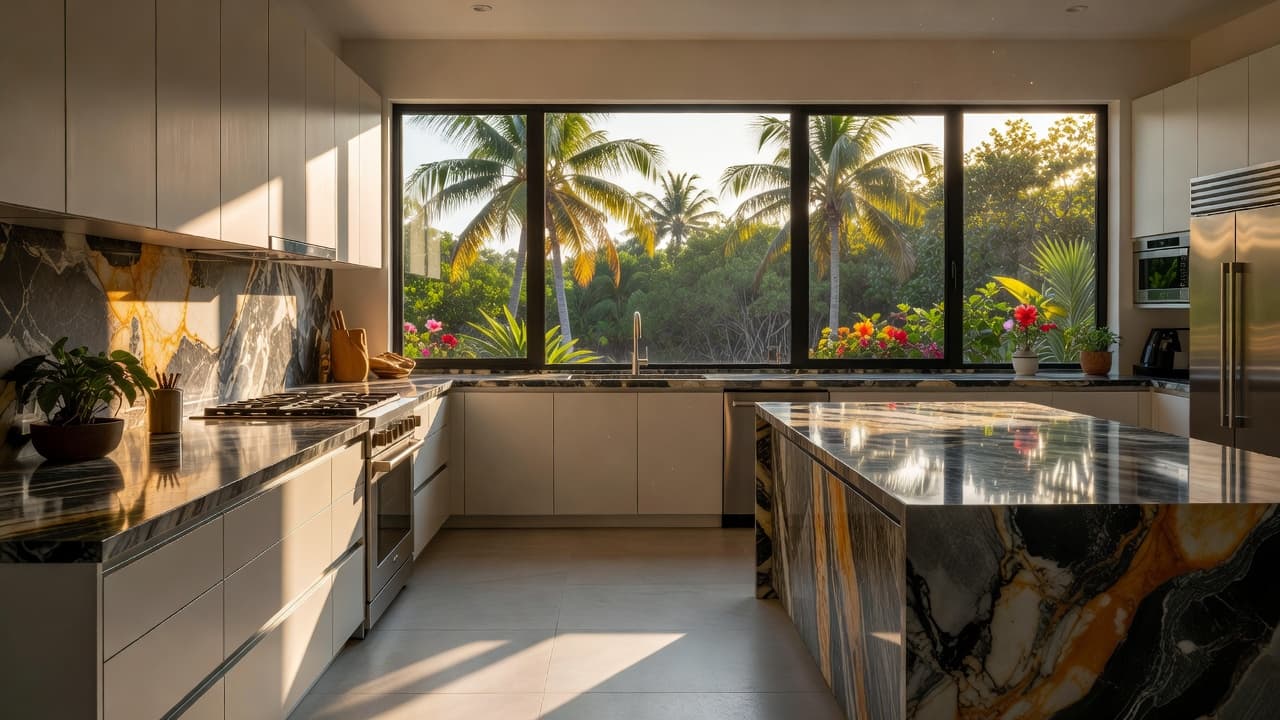
Natural stone movement can make a kitchen island the main visual feature of the room.
Quartzite vs Quartz Countertops: Side-by-Side Comparison
This comparison shows how the two surfaces differ in areas that affect daily kitchen use.
| Feature | Quartzite | Quartz |
|---|---|---|
| Material | Natural stone | Engineered stone with resin |
| Appearance | Unique veining and variation | Consistent color and pattern |
| Porosity | Some porosity | Nonporous under normal use |
| Sealing | Usually requires periodic resealing | No routine sealing |
| Heat resistance | Strong, although trivets are still wise | Lower heat tolerance because of resin |
| Scratch resistance | Very high for quality stone | Very high for everyday use |
| Stain resistance | Strong with proper sealing and care | Strong with simple cleanup |
| Sun exposure | Generally better suited to strong sunlight | UV exposure may affect color or resin |
| Repairs | Chips and stains may require stone repair | Chips may require color-matched repair |
| Cost | Often higher, depending on slab and fabrication | Wide range, including premium options |
The main takeaway is simple: quartzite demands more care but offers natural stone performance , while quartz provides a lower-maintenance surface with greater design consistency.
Neither material is indestructible. Heavy objects can chip an edge, abrasive cleaners can dull a finish, and poor installation can create problems with either surface. A professional fabricator should review support, seams, sink cutouts, overhangs, and the thickness of the selected slab.
How Southwest Florida Conditions Affect Your Choice
Southwest Florida kitchens face conditions that differ from those in a darker, cooler climate. Large windows and sliding glass doors can fill a room with direct sunlight for much of the day. Open floor plans may also place an island near a lanai, pool area, or south-facing window.
Quartzite generally handles sunlight better because its color comes from natural minerals rather than resin. However, the exact slab still matters. Ask your fabricator about the stone's finish, sealing requirements, and suitability for the planned location.
Engineered quartz requires more careful review when direct sun is involved. Many manufacturers distinguish between indoor installations and exterior applications. Prolonged ultraviolet exposure can contribute to fading, yellowing, or changes in the resin system, and some warranties exclude outdoor use. A quartz surface inside a kitchen may perform well for years, yet that doesn't automatically make the same product appropriate for an outdoor kitchen.
This distinction matters in Naples, Sarasota, Fort Myers, and coastal homes with wide expanses of glass. If sunlight reaches the counter for several hours each day, ask the manufacturer for written guidance on UV exposure. Don't rely only on a small showroom sample.
Outdoor kitchens need a separate material review. Quartzite may be a better candidate for a covered or open-air cooking area, but the slab, installation method, and sealer must suit outdoor conditions. Quartz is usually a stronger choice for the indoor kitchen, where it stays protected from direct weather and extreme temperature swings.
Humidity itself doesn't damage a properly installed quartz or quartzite counter. Still, moisture makes sound cabinetry, accurate seams, and proper sink installation important. A countertop can't compensate for cabinets that shift, leak, or lack adequate support.
Which Countertop Works Better for Your Kitchen?
The best choice in a quartzite vs quartz countertops comparison depends on your priorities. Use this framework before selecting a slab.
Choose quartzite when natural variation matters
Quartzite fits homeowners who want a one-of-a-kind island or a stone surface with depth. Veins can run across the slab in ways that manufactured patterns can't fully reproduce. The material also suits kitchens where hot cookware, baking, or frequent meal preparation are part of daily life.
Quartzite works well with transitional, coastal, Mediterranean, and modern designs. A softly veined cream slab can pair with light oak cabinets, while a darker stone can anchor white cabinetry and brushed metal fixtures.
You should accept the care that comes with natural stone. Seal the surface as recommended, wipe spills promptly, and use a pH-neutral stone cleaner. Don't assume every quartzite slab has the same porosity. Some stones absorb more quickly than others, so a fabricator should test the selected material.
Choose quartz when easy care is the priority
Quartz works well for active households, rental properties, second homes, and homeowners who don't want to schedule sealing. Daily cleaning usually requires a soft cloth, warm water, and mild soap. The nonporous surface also gives you more room for error when a coffee cup or bottle of olive oil sits on the counter overnight.
Consistent patterning helps when you need multiple slabs for a large kitchen. It can also simplify cabinet and backsplash coordination. If you want a calm surface without strong movement, quartz offers many practical choices.
Use trivets under hot pans and baking dishes. Resin-based surfaces can discolor or suffer damage from high heat. You should also confirm the product's UV guidance before installing quartz near large windows or outside.
Consider how the kitchen connects to outdoor living
Many Southwest Florida kitchens open directly to a covered patio or pool deck. In that case, choose the indoor and outdoor surfaces separately rather than assuming one material fits both areas.
Quartz may be ideal inside, while a properly selected natural stone works better outdoors. Your builder and stone professional can coordinate colors without forcing the same product into two different environments.
Design, Fabrication, and Installation Matter
A beautiful slab can still disappoint if the layout ignores its pattern. Before fabrication, review the slab placement for the island, perimeter counters, backsplash, and seams. Strong veining may need bookmatching or careful alignment, which can increase material use and fabrication time.
Edge profiles affect both appearance and durability. A slightly eased edge reduces the sharp corner found on some square profiles. Large islands may also need added support, especially when the design includes seating overhangs.
Sink cutouts deserve attention in busy kitchens. A properly finished edge around an undermount sink helps prevent chips and makes cleaning easier. Appliance clearances, cooktop cutouts, and dishwasher support should also be confirmed before the stone is cut.
Countertop selection is only one part of a full renovation. Cabinet condition, electrical work, plumbing changes, flooring, backsplash installation, and permits can affect the schedule. Sozio Building Company's Southwest Florida kitchen remodel guide covers local considerations such as permits, inspections, humidity, and project phases.
For a complete update, custom kitchen remodeling can coordinate the countertop with cabinets, lighting, appliances, and the room's layout. That coordination helps prevent a common problem, choosing a slab before confirming how the entire kitchen will function.
Before approving a material, bring these questions to your remodeling team:
- Will direct sunlight reach the counter every day?
- Is the surface intended for an indoor kitchen, a covered outdoor kitchen, or both?
- Does the quartz product have outdoor or UV restrictions?
- How often does the selected quartzite need sealing?
- Where will the seams fall on the island and perimeter?
- Does the cabinetry provide enough support for the planned overhang?
- What care products does the manufacturer recommend?
A professional onsite review can also reveal structural or layout issues that samples won't show. If you're planning a kitchen or custom-home project, you can Get a Free Estimate to discuss the space, materials, and installation requirements.
Conclusion
For Southwest Florida kitchens, quartzite vs quartz countertops is a decision about lifestyle and location, not a contest with one universal winner. Quartzite offers natural character, strong heat performance, and better flexibility for sun-exposed applications. Quartz offers consistent design, simple cleaning, and no routine sealing for protected indoor spaces.
Choose quartz when low maintenance and pattern control matter most. Choose quartzite when natural movement, heat resistance, and long-term stone character matter more. In either case, review the actual slab, confirm sunlight limitations, and plan the fabrication details before construction begins.